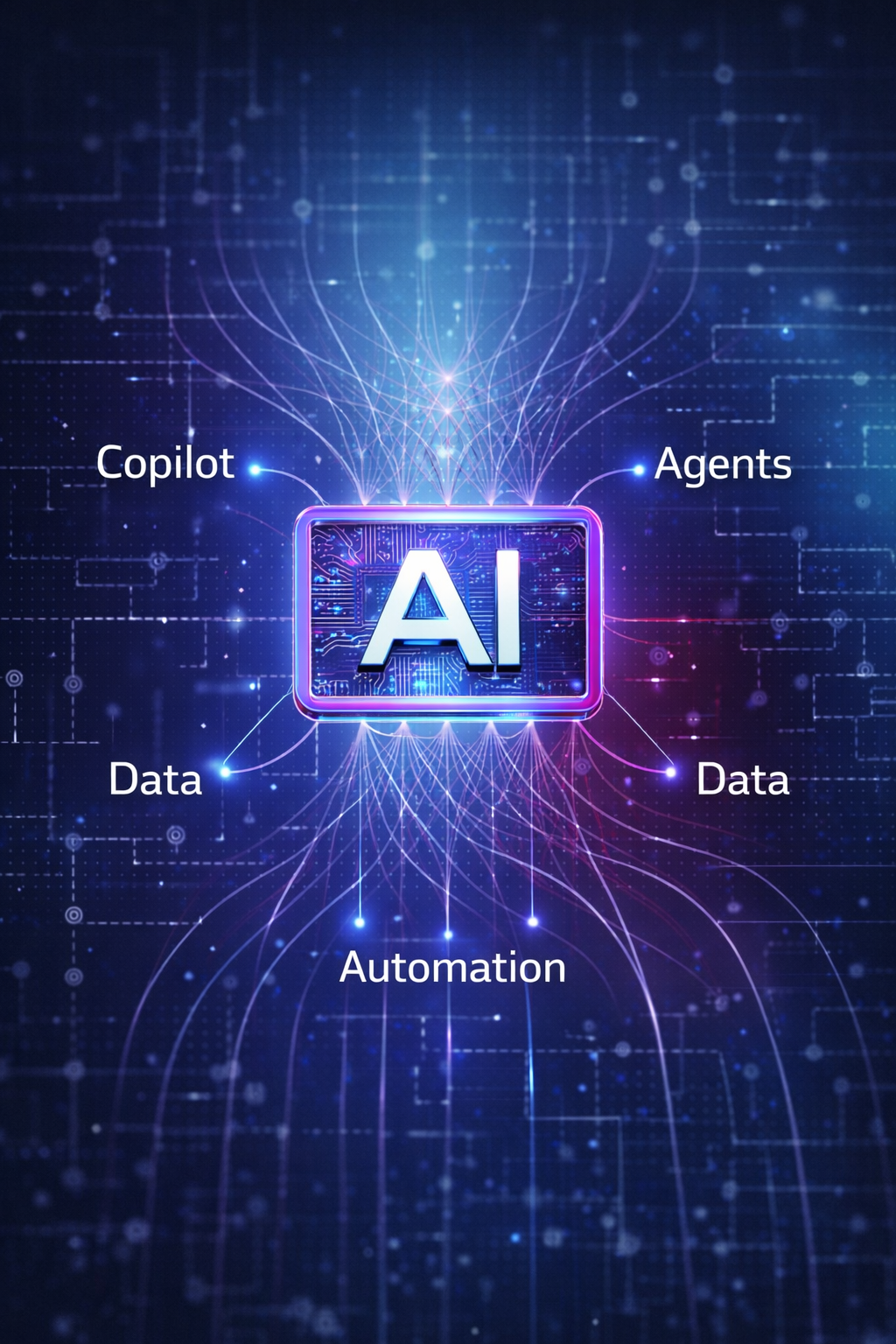
What we deliver:
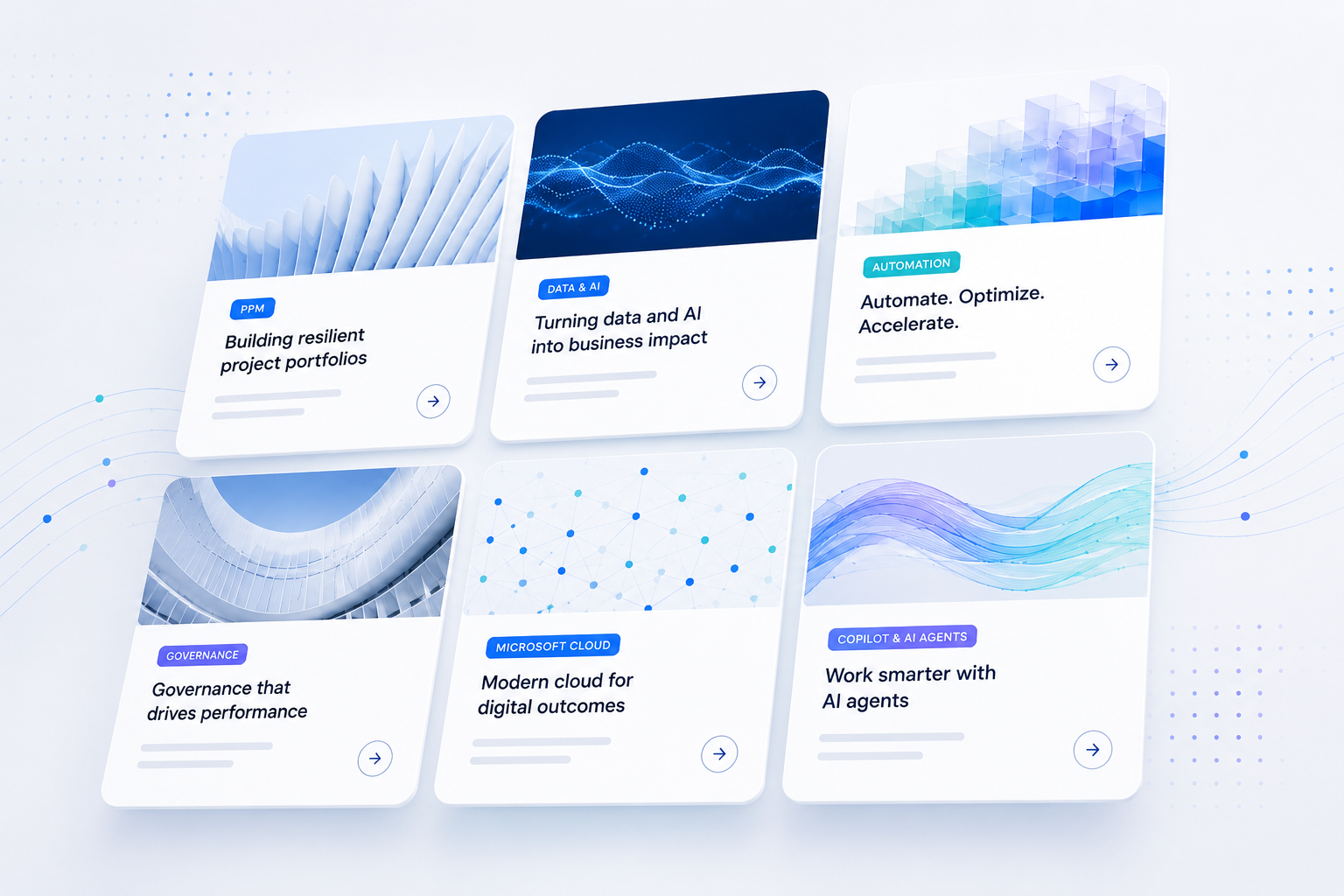
Make Copilot practical for PPM teams (scenarios, governance, adoption).
Build role-based AI agents on your portfolio data (PMO, portfolio, risk).
Establish Data & AI Governance so solutions scale safely.


Copilot without portfolio context doesn’t change decisions.
PPM data is fragmented across tools, workspaces, and security boundaries.
Reporting is manual, inconsistent, and hard to trust.
PoCs happen, but there is no path to production, adoption, and measurable value.
We help you move from one-off experiments to a governed, portfolio-aware AI capabilities that actually changes decisions – not just demos.
We connect your AI ambition to portfolio outcomes and the reality of your data landscape — so you can make confident decisions and fund the right work.
What we do
Facilitate strategy workshops aligned with your portfolio decision agenda
Assess data and process maturity across Microsoft 365 and PPM tooling
Identify and prioritize AI use cases (quick wins to strategic bets), mapped to value and risk
Define a “PoC-to-scale” path: phases, ownership, architecture boundaries, and an adoption plan
Typical deliverables
AI & PPM use-case backlog (with value/risk scoring)
Data readiness findings and remediation recommendations
3–6–12 month roadmap with waves, owners, and success measures
We make Copilot a practical tool for project organizations — not just a demo — by grounding it in real PPM scenarios, permissions, and adoption.
What we do
Copilot readiness for project organizations: information architecture, access model, and content hygiene
PPM scenarios: planning support, status narratives, risk/issue analysis, executive Q&A, and meeting preparation
Governance and security setup: boundaries, sensitive information handling, and role-based access
Impact measurement: reporting cycle time, decision lead time, adoption signals, and data quality improvements
Typical deliverables
Copilot for PPM scenario library (role-based prompt playbooks)
Governance and access design recommendations
Adoption enablement plan (training, usage patterns, and metrics)
We build AI agents and lightweight apps that understand your portfolio context — and can execute repeatable work safely, with guardrails.
What we do
Design and build role-based agents: PMO assistant, portfolio analyst, risk reviewer, sponsor brief generator
Connect agents to PPM and operational systems (where relevant): Planner Premium / Project Server Subscription Edition / OnePlan, plus Finance / HR / CRM
Define guardrails: retrieval boundaries, citations, approvals, auditability, and escalation paths
Build a Proof of Concept with selected teams, then harden for production (reliability, monitoring, governance integration)
Typical deliverables
Working PoC agent(s) for selected roles
Integration approach and data access model
Production hardening checklist and release plan
AI only scales when data is trusted and the operating model is clear. We help you put the rules in place without slowing delivery.
What we do
Data policies for AI: classification, ownership, access, and retention
Governance model for Copilot and agents: roles, approval workflow, and change control
Monitoring and risk management: quality review, user feedback loops, incident handling, and continuous improvement
Portfolio linkage: treat AI initiatives as first-class items with clear go/no-go criteria
Typical deliverables
Data & AI governance pack (roles, processes, templates)
KPI recommendations and steering cadence
Policy and control mapping for AI-enabled scenarios
Executive Portfolio Co‑Pilot
A chat-based assistant for executives and the PMO that uses data from Planner Premium, Power BI, and key documents to answer questions on status, risk, and priorities, and recommend options such as accelerate, pause, or re‑prioritize.
Copilot‑Driven Status & Meeting Assistant
Copilot in Teams / Outlook that generates status reports, steering/portfolio meeting summaries, and action lists based on emails, chats, and files in Microsoft 365 – ready for PMO and leadership to review and use.
Portfolio & PMO Q&A Chatbot / Voice Bot
An assistant in Teams (chat or voice) connected to Planner Premium, Power BI, and core PMO documentation (methodologies, templates, governance) that answers on‑demand questions about status, processes, and standards.
Project & Delivery Knowledge Base Assistant
An agent working across your documents (Confluence / SharePoint / OneDrive – Word, PDFs, presentations) that lets project and delivery teams quickly find answers, templates, and past decisions from previous initiatives.
Internal AI Assistant (“Secure ChatGPT for Employees”)
A private, company‑grade AI assistant that employees can safely use instead of public tools, answering questions using internal documents and systems while enforcing permissions and compliance.
AI‑Powered Invoice Review & Triage
An AI service that classifies, validates, and routes incoming invoices based on natural‑language business rules, sending clean items straight into the accounting system and flagging only exceptions for human review.
Custom AI Agents Aligned to Your PMO & Delivery Needs
Dedicated agents for governance & compliance, risk & dependency analysis, digital stand‑ups, sponsor briefs, and more – designed around your specific processes, tools, and data rather than one‑size‑fits‑all solutions.

After a 6–12 week engagement, clients typically see:
A clear set of automation and AI use cases prioritized by value, effort, and risk
A validated data and tool landscape view (Microsoft 365 + PPM) with practical next steps
A working pilot (PoC) for 1–2 priority workflows (e.g., reporting, intake/triage, PMO Q&A)
A scale plan: rollout approach, ownership, and success metrics for wider adoption
Lightweight Data & AI governance essentials to support safe scaling (roles, KPIs, cadence)
Step 1 — Discover & Prioritize (1–2 weeks)
Align stakeholders, confirm data sources, and prioritize use cases based on value, feasibility, and risk.
Step 2 — Build a Pilot (2–4 weeks)
Deliver a working pilot for 1–2 priority scenarios — for example a knowledge assistant (RAG chatbot), voice-to-action meeting assistant, AI-ready knowledge base, or a targeted process automation — validated with real users and real data.
Step 3 — Scale & Embed (4–8 weeks)
Expand to additional workflows, improve reliability and monitoring, enable adoption, and define ownership for ongoing improvement.
Fixed-price pilot projects (ideal for quick validation)
Implementation sprints (time-boxed delivery to scale)
Advisory / retainer (when you need ongoing steering and continuous optimization)